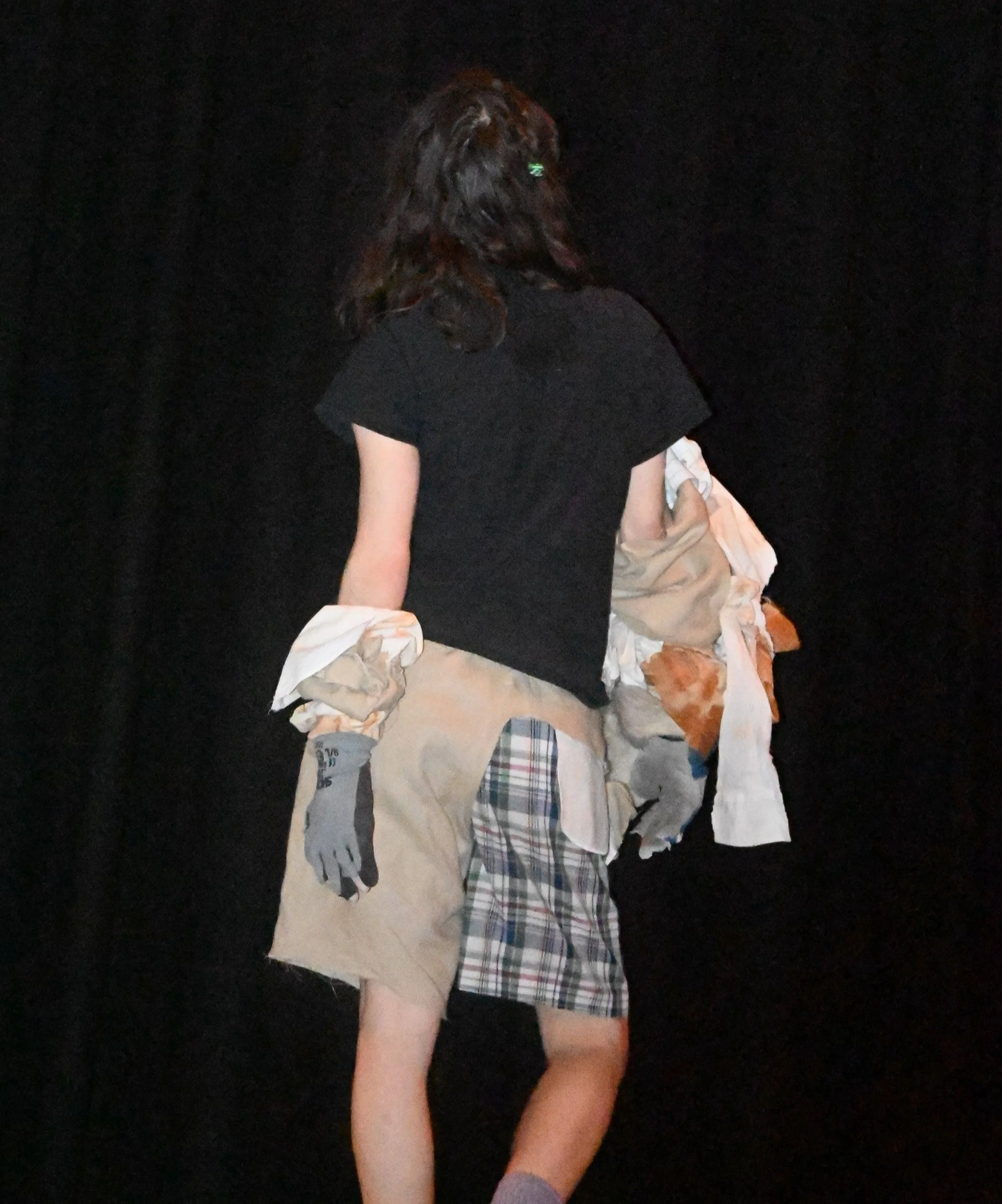
Moving through and with material residue that spills over from various artistic processes/mediums (sound, sculpture and performance), my practice investigates and questions how we define functionality of systems (mechanical, social and physiological). Sculptural and performative use of found, discarded objects considers where endings lie, if they lie at all. What is functional/waste if not bound to conventions of finality, time-based utility or ‘use-by’s’? Materials encountered at their end- oxidized metal, table frames, rags or fragmented words which have exhausted their use- are taken simultaneously into processes of preservation and further destruction. In ‘Outside I, Encounter You as Pearl’ surfaces of materials are considered as edges which enable exploration of temporal expansion, through durational rusting that contaminates and defaces fabric pieces, and temporal contraction, when stains are partly fixed/ contained by salination. A pearling which does not rest nor terminate at a luxurious object. Rather pointing toward but failing to reach death, through extending/returning to material expiration- meaning both to die or to exhale. A grim pearling.
OOD and Organ Orchestrating Wasteland performance take exhalation as waste and a substance of life, and expired objects as containers for expired breath, to question what preserves what? Sounds made from repeatedly breathing into discarded pipes are brief, and inflated latex gloves, in later sculptural pieces are short lived, eventually deflating. Softening the boundaries of preservation, including preserved time, ties into Bataille's notion of the erotic as that which moves toward death, a slow release from containment (of the self). These grim pearls are not the graspable sounds or sculptural forms partly actualized through breath, but the act of failed resuscitations. They are the event, in a Deleuzian sense; the space of passage between past and future, creating a symbiotic relationship between multiple temporalities and thus lacking a specific site of origin or destination. A dynamic suspension in multiple times is explored performatively in the works of New Noveta and Eve Stainton (Impact Driver, 2024) whose work remains unresolved through non-linear and anti-climactic choreographies. In my performances, suspension is explored choreographically (through nonlinear catwalks and the contrapose) and sonically through unresolved dialogue and feedback. Indeed, in The Delayed Present, Wolfgang Ernst reflects on how the spark- that enables and activates digital communication is in fact not punctual (on time) nor a single point (in time) but a fluctuation of electro-magnetic waves. In ‘With Excreted Speech’ evocative of Tim Etchells ‘From Signal to Noise’, includes excessive lags, displaced voice, manual and electronic feedback of words/sounds ironically punctuate the space through oscillations (between live and recorded) suspended temporally.
Performance and documentation structures extend material investigations of surfaces, edges and containment as a way of exploring systems of communication, through dislocating subjectivity and technological functioning. ‘Music is Detected and May be Suppressed' a durational Microsoft Teams meeting compresses the vitality of the performing bodies- rendered flat onto a surface of the PC. Yet through a static digital background within the screen a layering of multiple screens creates a cavity, across and through which bodies are seen/move. Motion toward and away from the surface forefront bodies as between formats and multiple dimensions of interaction. The GIF, a poor image which, as Hito Steyerl states, is rendered without origin by its circulation in technological domains does not reach for a singular point/climax, rather points toward the space and speeds of sharing. Its deteriorated quality deterritoralizes the performance visually and temporally, by moving away from a stable resolution or subject body towards connection though suggested trajectories of movement.
Drawing parallels to the diluted quality /resolution of GIF that enables consumption of the image through saturation of communication systems/internet, Grayson Perry notes that objects are made consumable by becoming more tame/less ornamental (ICA panel discussion, What is the Use of Ornament). Saturating collaborative performances and sculptures with the excessive invites an indigestibility which queers mainstream movement patterns of capitalism and industry/ institutions that rely on use, consumable objects and compression of bodies. My practice serves as a container for the circulation of the erotic (defined by Bernard Tschumi as not excess pleasure but a pleasure of excess). Grossly ornamented materials, for instance latex gloves decoratively drenched with death and grossness, through processes of coagulation, rusting and deflation are brought into cycles of resuscitated use. A container which embodies a tension between centralised norms of mechanical/social functioning and outskirted bodies/brains that cannot be easily contained within systems of conventional communications.
Deleuze's Fold becomes a form through which ideas of movement between expansion/periphery and contraction/inflection can be manifest/conceptualised dispersal of things to multiplicities of existence- While Annie Tatton’s fashion thesis argues that fashion items survive on what they exclude- i.e. the body- Annike Senik writes, in Fashioning the Fold, that folds detteritorialise fabric from the human body becoming active in their own right- apart yet not detached from body. Extended gloves and folded costumes become physical manifestations of the fold but also in keeping these within performance sites without the body activates their multiple possible roles and functions that refuse or collapses distinctions of dysfunctional-functional (edge-center). Material explorations of expanding multiplicities of function through sound and costume and how they are worn out in performance remains a continued anchor in my practice.